Most print on demand (POD) sellers don't struggle because they lack ideas.
They struggle because they don't have a clear workflow to turn ideas into listings.
Without a system, ideas get lost, research gets repeated, and uploads become inconsistent.
This guide walks through a step-by-step POD workflow you can follow from idea capture all the way to publishing a listing. The goal is simple: help you move faster, stay organized, and make better decisions.
Why You Need a Defined POD Workflow
If your process looks like "idea → design → upload," you're skipping critical steps.
A strong workflow helps you:
- Avoid wasting time on weak niches
- Create more targeted designs
- Improve listing visibility
- Stay consistent over time
Think of this as your production system, not just a creative process.
The Complete POD Workflow (Step by Step)
1. Idea Capture
Every POD business starts with ideas. The problem is most people don't capture them properly.
What to Do
- Log every niche idea immediately
- Don't filter too early
- Include context (audience, scenario, tone)
Example:
- "Introverted fisherman humor"
- "Subaru camping family"
- "Night shift nurse sarcasm"
Ideas are raw inputs. Capture first, refine later.
2. Niche Research
Once you have an idea, validate whether it's worth pursuing.
What to Check
- Are there existing listings?
- Do listings have reviews?
- Is the niche too saturated or still open?
Example:
Search "Bass Fishing Dad Shirt"
Look for reviews and design quality
You're looking for proven demand with room to compete.
3. Keyword Planning
This step determines whether your design will be found.
What to Identify
- Primary keyword (main phrase)
- Secondary variations
- Long-tail keywords
Example:
Primary: "Funny Nurse Shirt"
Variations:
- "Night Shift Nurse Tee"
- "RN Humor Shirt"
Keywords connect your product to buyers.
4. Design Brief Creation
Before opening your design tool, define what you're making.
What to Include
- Target audience
- Design angle (humor, pride, sarcasm)
- Style (text-only, badge, illustration)
- Key phrase or message
Example:
Niche: Subaru Camping
Audience: Introverted campers
Angle: Humor
Concept: "Go Away, I'm Camping"
A clear brief prevents random design decisions.
5. Listing Preparation
This is where many sellers lose visibility.
What to Prepare
- SEO-optimized title
- Keyword-rich description
- Tags and bullet points
- Mockups or product images
Example:
Bad Title: "Cool Camping Shirt"
Good Title: "Funny Subaru Camping Shirt – Introvert Camper Gift"
Strong listings increase discoverability and conversions.
6. Publishing and Tracking
Once your listing is live, the work isn't done.
What to Track
- Where the design is uploaded
- Keywords used
- Performance (sales, clicks)
- Variations created
Publishing without tracking = no learning.
Putting the Workflow Together
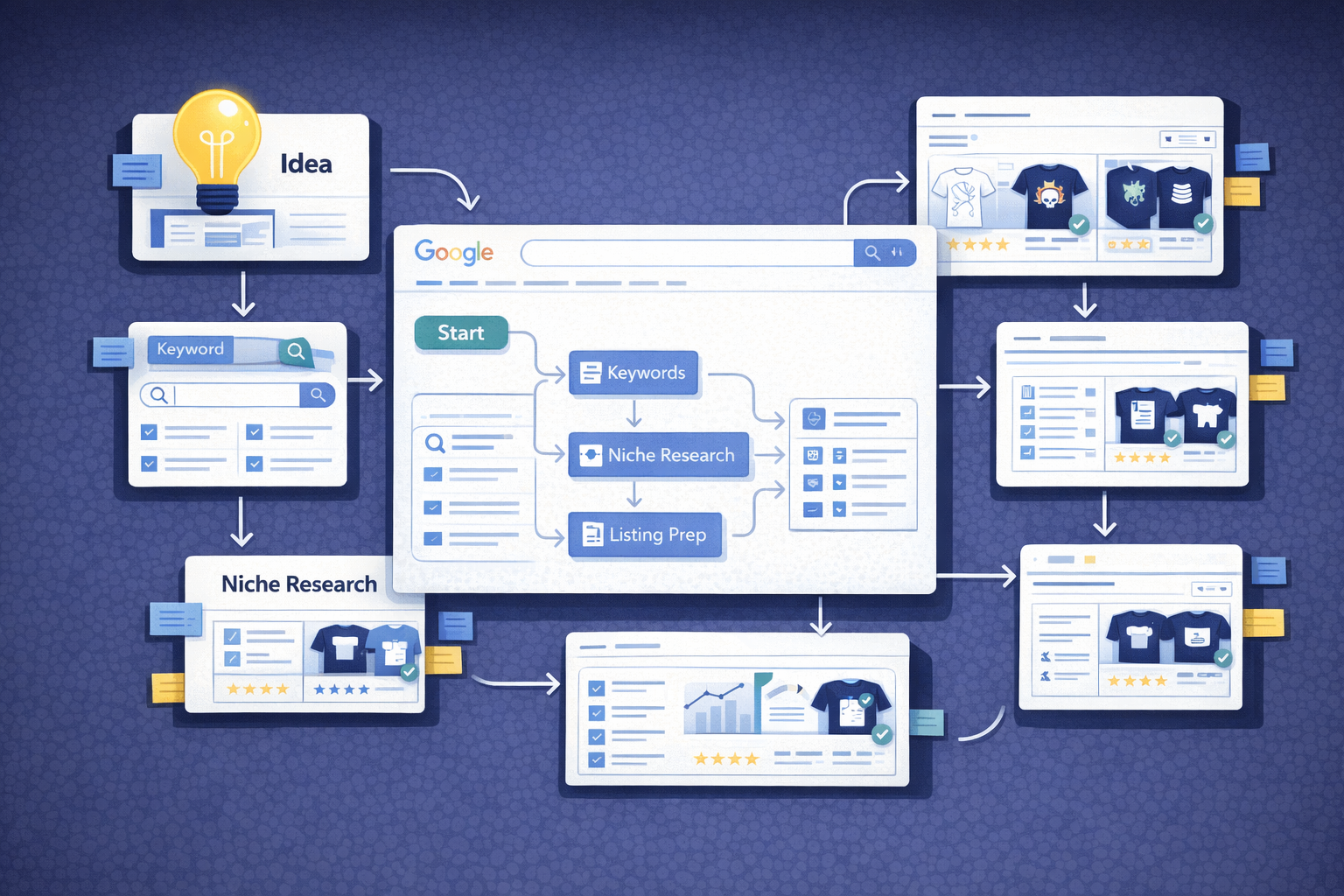
Here's the full flow:
Each step builds on the previous one.
Skip a step, and your results suffer.
Example: Workflow in Action
Unstructured Approach
- Random idea
- Quick design
- Upload with basic title
- No tracking
Result: Low visibility, no growth.
Structured Workflow
- Capture idea: "Dog Mom – Golden Retriever"
- Validate niche demand
- Identify keywords
- Create design brief
- Optimize listing
- Publish and track
Result: Higher chances of visibility and repeatable success.
Where Most POD Sellers Break Down
- Ideas are not documented
- Research is inconsistent
- Keywords are guessed
- Designs lack direction
- Listings are rushed
- No tracking system exists
This leads to wasted effort and slow progress.
How PODTrackerPRO Connects the Workflow
Instead of managing each step separately, PODTrackerPRO acts as your central operating system.
You can:
- Capture and organize niche ideas
- Track research and validation notes
- Store keyword plans and variations
- Create structured design briefs
- Manage listings and monitor progress
It connects every step into one streamlined workflow.
The Real Advantage: Speed + Clarity
When your workflow is connected:
- You move faster
- You make better decisions
- You avoid repeating work
- You build momentum
That's how consistent sellers outperform everyone else.
Final Thoughts
A successful POD business isn't built on random uploads.
It's built on a repeatable workflow that turns ideas into optimized listings.
If you follow this process:
- Capture ideas
- Validate niches
- Plan keywords
- Define designs
- Optimize listings
- Track results
You'll operate at a completely different level.
Ready to Build a Real POD System?
If you want to connect your entire workflow and stop juggling scattered tools, PODTrackerPRO gives you one place to manage ideas, research, keywords, and listings.
You don't need more effort.
You need a better system from idea to listing.
Systematize your POD business.